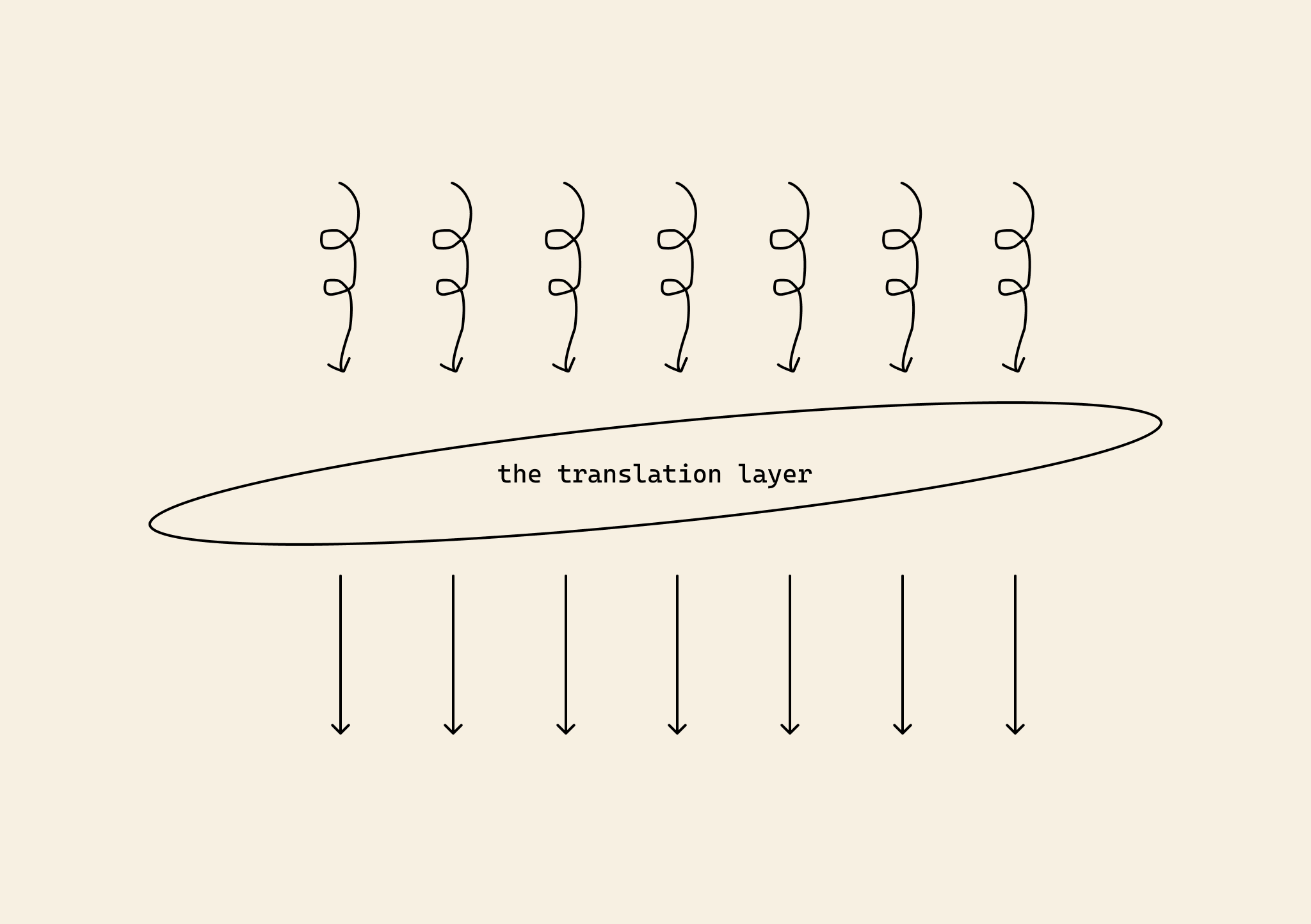
Every organisation speaks two languages: the language of intent and the language of execution.
The language of intent is the language a company thinks in: its worldview, strategy and conviction. This language is usually alive in the founders’ heads and leadership rooms. It’s usually ambiguous given the lack of articulation, but also generative and context-rich.
The language of execution is the language an organisation acts in, and is more precise and measurable. It says what to build, by when, and how you’ll know it worked.
Meaning originates in the first language and has to arrive intact in the second language for it to become something the real world can see and understand. Someone—or something—has to carry meaning across in a not-lossy way. I call this the Translation Layer.
The Translation Layer is where the organisation’s intent gets rendered into forms that humans can act on. It encompasses everything that carries meaning between the two layers and also radiates that meaning outwards to anyone with any stake in your organisation.
This layer exists in every organisation, whether or not it’s staffed deliberately. At startups and smaller companies, it’s usually latent and accidental, given the size of teams are small enough to afford understanding by osmosis. In larger organisations, this layer has a more load-bearing capacity, and calls for much more deliberation in designing how it works and who works in it.
(This is especially true now that, with AI, software and technology being more and more commoditised, the new differentiator is an org’s causal narrative and how it translates into real world applications).
Why translation?
The English word translation comes from the Latin noun translatio, which means “a carrying across”. Translation carries intent from one form to another, preserving meaning across this change of form. It is much more than mere communication, which is a passive reproduction of someone else’s voice, or transliteration, which mechanically swaps symbols line-for-line without ever touching the underlying context.
To translate is to enter into a deep, active relationship with the meaning of something. Jhumpa Lahiri, world-renowned writer and translator from Italian to English, writes:
“Far from a restrictive act of copying, a translator restores the meaning of a text by means of an elaborate, alchemical process that requires imagination, ingenuity, and freedom.”
In the same way, an organisation’s Translation Layer doesn’t exist to just parrot strategy down to execution teams or relay raw metrics from to the floor to the executives. True translation in the context of an organisation requires taking abstract, high-context intent and finding the precise formats, rituals, artefacts, and structures that preserve its essential truth as it travels across disciplines and scale.
Translation as a horizontal layer
There’s a reason I see this translation as a layer rather than another function in an org chart. It isn’t a neatly bounded territory, and it can’t be contained within a single department. In my experience, the Translation Layer inherently cuts across brand, communications, PR, ops, docs, HR, design, and more. Where these functions own their specific domains of output, the Translation Layer is the horizontal substrate that mediates how meaning flows through and out of all of them.
Translation that happens in this layer can be inward- or outward-facing.
Inward-facing translation is when intent becomes behaviour within the organisation. Think onboarding, rituals, docs, growth frameworks, org design and other ways that a narrative founds an organisation’s operating system.
By contrast, outward-facing translation is the ways that intent becomes reputation. This includes brand, editorial, founder comms, and cultural artefacts.
The Translation layer is also bidirectional in that it translates upwards, too. (A layer that translates only downwards is just propaganda.) It turns ground-level reality into forms with enough detail and “need” context that org leaders feel compelled to act on it.
As I mentioned earlier: in smaller companies, this sort of translation work tends to happen naturally, because of the sheer high chances of everyone being in the same room at the same time.
In the ideal world, even when teams scale up and fragment, every artifact echoes the same original frequency. But when this layer is left unaddressed, the delta between what was meant and what was received widens at every handoff, until each team ends up speaking its own private dialect that creates confusion and often strife. The threshold at which founders decide the Translation Layer is worth actively investing in, is when meaning starts travelling through people who weren’t there when it was formed.

What it means to work in the Translation Layer
Working in the Translation Layer is an interesting in-between, because it’s neither pure strategy nor pure execution. Far from just producing content, it is about holding, shaping, and directing context.
In this work, the final artifact is merely a lagging indicator, a secondary output showing that a translation process occurred. The leading indicator is the shift in shared understanding. The value lies not in the memo, deck, or framework itself, but in the measurable increase in context density across the organisation that follows the translation work.
There are a few core mechanics at play in the Translation Layer.
The first is lossless compression. This is the ability to take complex, ambiguous, or highly technical inputs and compress them into something instantly graspable without stripping away their essential meaning or structural nuance. It’s essentially turning intent into a meme in the way evolutionary biologist Richard Dawkins originally defined it: a compact, self-replicating unit of culture. When compression is lossless, an idea can travel effortlessly from mind to mind across an organisation without mutating into noise.
The second is context arbitrage. Practitioners in the Translation Layer have to acquire context from one pocket of the organisation and supply it to another that lacks it. Their unique leverage comes from holding more disparate context simultaneously than anyone else involved in the conversation.
The third is format judgement. There’s an art and science to knowing how to select exactly the right vessel for a piece of meaning. Whether an insight should live as an all-hands story, a documentation standard, an onboarding ritual, or a product brief depends entirely on what format gives that specific meaning the highest probability of being understood and acted on.
What it takes to work in the Translation Layer
Because these roles are rarely bounded by traditional functional lines, they select for a very specific type of operator.
For one, it calls for a certain level of amoeba-ness. I wrote in my essay on amoeba roles in tech about how these sorts of roles need “meta skill of deep, rapid adaptation”. That skill goes a long way when you work in the translation layer, because you have to become what the gap of the day requires.
Downstream of that amoeba-ness is a perpetual slight outsider-ness in every room. To be a translator is to inhabit an in-between world, and not just in the conventional org chart. You must be fluent enough in every room’s dialect to earn trust, yet detached enough from its unspoken assumptions to preserve objective perspective. Being a slight outsider is both the price and the demand of being useful in all the important rooms.
Translation is also multiple acts of curation and judgement stacked in a trenchcoat. It happens on multiple fronts: what gets translated, what form that translation takes, who the final audience is and what dialect they understand, and how those gaps should be bridged. That means the quality ceiling of the Translation Layer is set by the practitioner’s own taste. You cannot translate a worldview you cannot first perceive and deeply understand.
In my experience, success in this layer often looks like personal invisibility. When I was heading content design at PhonePe, I would always tell my direct reports that the mark of excellent UX writing is how seamlessly the words disappear into the overall experience.
The same principle applies here: When the work is done with real precision and taste, the resulting clarity feels so natural that people assume it was always there. The act of translation—and the translator—disappears into the background, leaving behind only the shared understanding it created. Sometimes the highest proof of your leverage in the Translation Layer is that no one notices what you did in all the rooms.
(This is not the same as not being recognised for your work in a personal and professional capacity. Leadership must still understand and value the unique leverage you provide. What I mean in this context is being comfortable with your ideas becoming public domain.)
Every organisation eventually reaches its own version of the Narnia threshold: the moment that meaning must travel through people who weren’t in the room when it was forged. Up until that moment, intent moves by proximity and osmosis. Beyond it, intent only survives by translation.
The decision every leader eventually faces isn’t whether their organisation will have a Translation Layer, because it already has one. The real choice is whether that layer remains an accidental game of telephone, or becomes a deliberate, highly crafted system designed to hold the world together as the organisation grows.
Up next in this series:
- How does a Translation Layer break down, and what are its failure modes?
- How do you test whether your org’s causal narrative is actually reaching and being imbibed by people it’s supposed to?
- What is the tipping point that signals the best time to start deliberately staffing and investing in your org’s Translation Layer?